Address:
No.14 Nanhe 3rd Street, Jingkou Road, Shiling Town, Huadu District, Guangzhou, Guangdong, China
Email:cassiekong@angelkiss.cn
Phone / WhatsApp: +86 137 1938 5599

Address:
No.14 Nanhe 3rd Street, Jingkou Road, Shiling Town, Huadu District, Guangzhou, Guangdong, China
Email:cassiekong@angelkiss.cn
Phone / WhatsApp: +86 137 1938 5599


Buyers with experience in OEM handbag manufacturing know that the lowest factory quote rarely produces the lowest landed cost. Handbag production costs are shaped by interdependent variables — structure complexity, material behavior, hardware sourcing, packaging density, and defect rate — none of which appear on a supplier’s initial price sheet. Effective sourcing strategy requires understanding where cost actually lives in the production process. This article addresses those variables directly, from a manufacturing operations perspective.
Quick Take: What Experienced Buyers Should Know Before Reviewing a Factory Quote
What Experienced Buyers Should Know Before Reviewing a Factory Quote
The largest hidden cost drivers in handbag production are assembly complexity and hardware fragmentation — not material grade.
Suppliers offering the lowest unit price often introduce higher defect rates and longer sampling revision cycles, increasing total procurement cost.
Assembly-minute cost logic means that structural decisions — pocket placement, closure type, interlining method — affect labor cost more than most material substitutions.
Packaging and logistics optimization can reduce landed cost by 10–18% on mid-volume orders without any product change.
SKU fragmentation across a collection — mismatched hardware, inconsistent lining specs — silently degrades production scheduling efficiency and batch consistency.
Assembly complexity and hardware fragmentation drive handbag production costs more than material price. Many sourcing articles treat material cost as the primary lever — in real OEM production, however, assembly time accounts for a disproportionate share of per-unit labor cost. A bag with six exterior pockets, contrast piping, and recessed zippers requires substantially more assembly minutes than a clean, minimal silhouette at the same material grade.
Many buyers underestimate how quickly small specification changes affect production efficiency. When hardware specifications are not standardized across a product line, sourcing fragmentation increases and scheduling efficiency drops. Many OEM factories report that SKU fragmentation — buyers using three or four buckle sizes across one collection — disrupts line balancing, introduces QC bottlenecks, and increases per-unit inspection time by 20–30%.
Structural decisions — frame construction, base reinforcement, interlining density — further affect assembly-minute cost and return risk. Hardware tooling amortization also becomes a factor when custom components are produced in low volume: tooling cost is fixed, so lower-volume runs carry a higher per-unit amortization burden. Buyers who address these variables at the design phase, before sampling begins, consistently achieve better unit economics without quality trade-offs.
Handbag value engineering is a structured review of every design element against its functional requirement and cost contribution — the goal is to remove cost that adds no perceivable consumer value, without reducing structural or aesthetic integrity. It is not material downgrading. Aggressive substitution without functional analysis typically increases long-term return risk.
In practice, value engineering examines lining attachment methods, hardware mounting systems, zipper tape specifications, and reinforcement placement. Even minor adjustments yield measurable results. Switching from recessed zipper construction to a simplified access panel design, for example, can reduce assembly time per unit by 4–6 minutes — translating to meaningful labor cost reduction at 5,000+ unit volumes, with no visible quality difference to the end consumer.
Sampling revision cycles are another area where early engagement pays off. According to soft goods sourcing benchmarks, each additional sampling revision cycle in OEM accessory production adds 2–3 weeks to lead time and increases pre-production cost by 8–12%. Buyers who engage manufacturing partners at the specification stage — before the first sample is cut — consistently complete development in fewer rounds. Not every value engineering strategy is appropriate for every product category; higher-end lines may require construction methods that carry higher assembly cost as a non-negotiable quality signal.

Material decisions should be evaluated against their downstream effect on defect rate, assembly time, and production stability — not purchase price alone. You may have seen suppliers suggest that switching to lower-grade components automatically reduces cost. In practice, lower-grade materials often increase defect rate, extend inspection cycles, and elevate return risk — costs that rarely appear in the original quote but consistently surface in final landed cost.
A more reliable approach is material substitution with performance parity. Transitioning from cast zinc alloy to high-density zinc alloy hardware — optimized for weight and finish retention — can reduce unit price while maintaining durability standards expected in large-volume accessory manufacturing. Hardware finishes should also be evaluated for batch consistency: lower-grade plating processes produce measurable color variation across production batches, increasing inspection time and rejection rates.
For fabric and lining, materials with LWG-certified sourcing or equivalent traceability deliver better production stability — fewer batch-to-batch variations in surface behavior, shrinkage, and edge finishing. YKK zipper tape is widely referenced in OEM accessory production for its assembly consistency; it reduces zip alignment failures during production, a QC issue that disproportionately affects line throughput. Buyers sourcing into North American or European markets should also confirm material compliance with REACH and CPSIA testing requirements early in development — non-compliant materials identified at the inspection stage create costly delays and potential shipment holds.
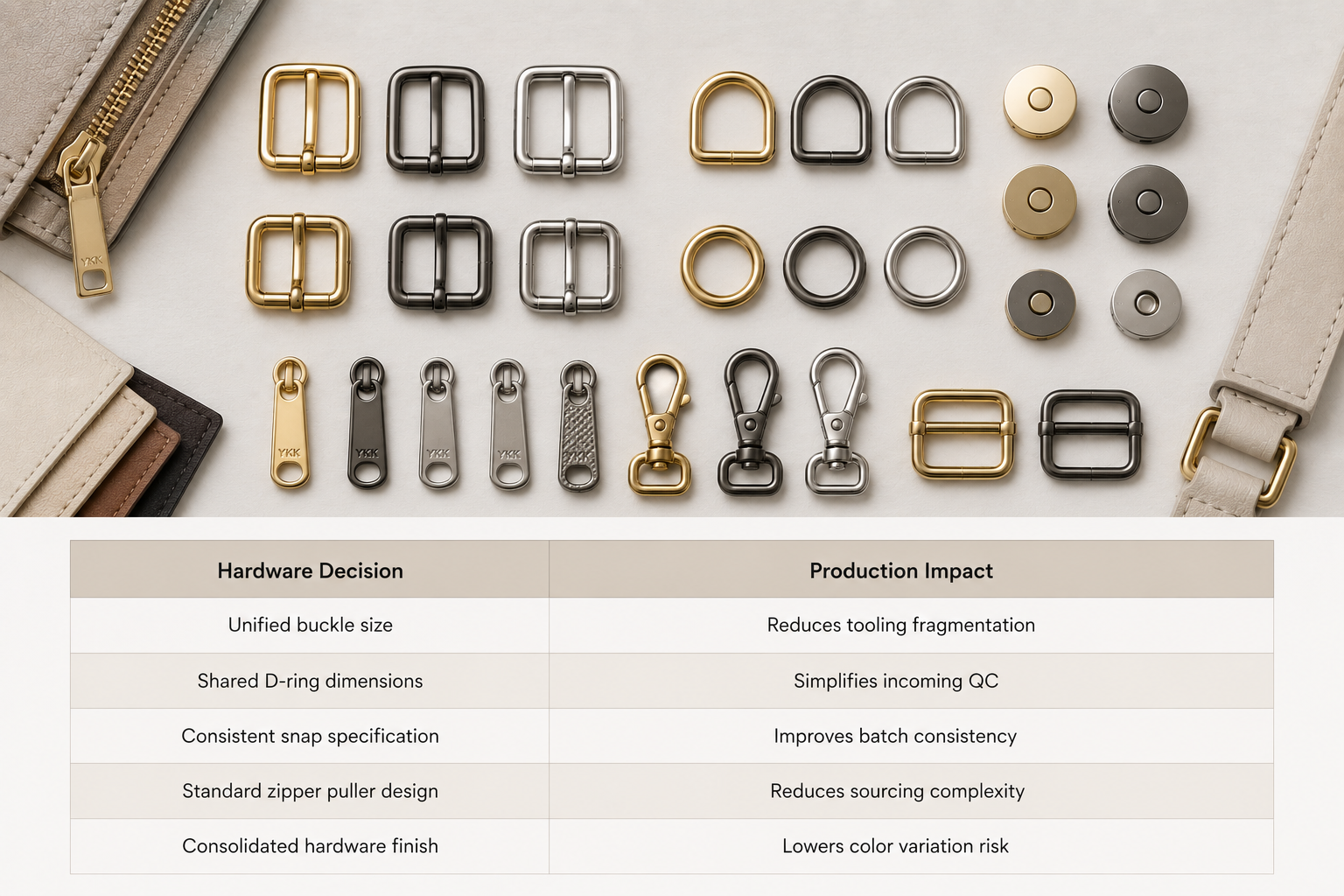
Hardware standardization across a collection — unified D-ring dimensions, shared snap specifications, consistent buckle sizing — reduces tooling fragmentation and improves supply chain integration. A buyer using three different buckle sizes across one collection forces the factory to manage separate tooling sets, separate incoming QC processes, and separate hardware inventory buffers. Consolidating to a single specification has been shown in soft goods manufacturing practice to reduce hardware-related line stoppages measurably
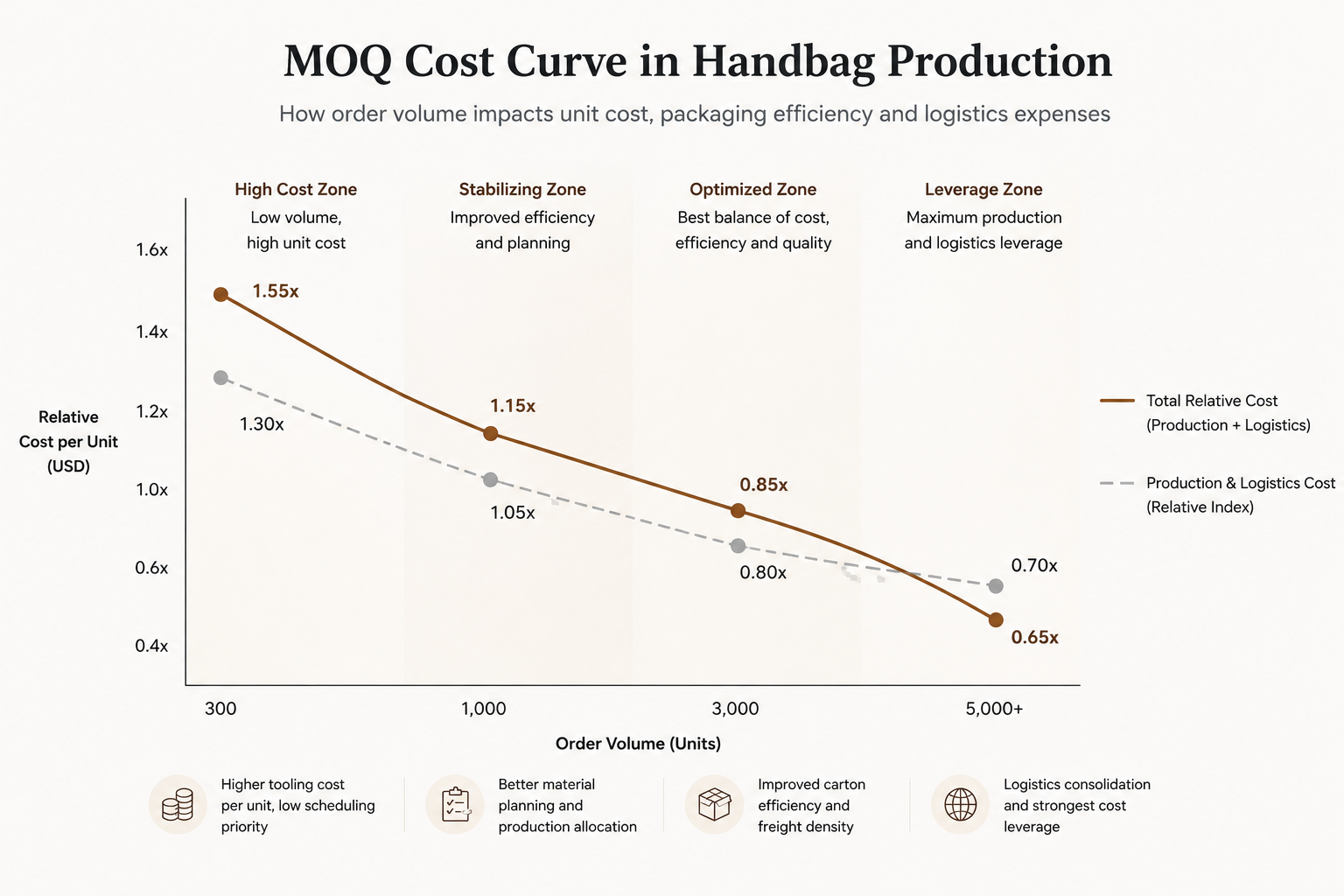
MOQ compression increases unit price, reduces scheduling priority, and shortens lead time — all of which elevate quality risk. Extreme MOQ compression may reduce scheduling flexibility and push production into off-peak slots where line balancing is less stable. Low-volume production runs also carry higher per-unit tooling amortization and reduce the factory’s ability to absorb material waste within acceptable cost tolerances.
Packaging is a consistently underutilized lever. Carton optimization — engineering box dimensions to maximize cubic meter efficiency — directly affects freight cost per unit. In large-volume accessory manufacturing, freight density improvements of 12–18% per container are achievable through carton redesign alone. On a 3,000-unit mid-size handbag order, this improvement can meaningfully reduce per-unit shipping cost on ocean freight lanes from Asia to North America or Europe.
Logistics consolidation compounds these gains. Buyers sourcing multiple SKUs from suppliers operating within an integrated supply chain ecosystem reduce coordination overhead, consolidate container loading, and lower per-unit freight cost. Fragmented sourcing across unconnected suppliers adds invisible cost through split shipments, misaligned lead times, and increased import documentation overhead — none of which appear in the original factory quote.
Yes — but only when cost reduction is structured around production analysis, not price negotiation. Reactive cost negotiation after sampling forces factories to compress margin, which translates into reduced QC rigor, component substitution, or compressed lead time. None of these outcomes serve the buyer’s long-term cost position.
Proactive cost optimization — through value engineering, material substitution with performance parity, MOQ planning, and logistics consolidation — reduces handbag production costs without introducing new defect risk or extending return exposure. The operational prerequisite is a manufacturing partner with visibility into where cost lives across the full production process: assembly-minute analysis, hardware sourcing consolidation, packaging density planning, and QC workflow design.
With over 12 years of OEM and ODM production experience across leather goods, synthetic materials, and multi-component accessory lines, the pattern is consistent: buyers who engage at the design and specification stage, rather than at the quoting stage, achieve the most durable cost improvements — without quality trade-offs that surface in the market.
Assembly time from structural and hardware complexity. Simplifying construction — standardizing hardware, reducing pocket complexity, streamlining lining attachment — typically delivers more cost reduction than material substitution, with lower quality risk.
Not reliably. Low MOQ production carries higher unit pricing, reduced scheduling priority, and higher per-unit tooling amortization. Consolidating orders to volumes that support stable line efficiency typically produces a lower landed cost overall.
A structured review of every design and construction element against its functional contribution and unit cost impact. The goal is to remove cost that adds no consumer value — through simplified construction, hardware consolidation, or material substitution with performance parity — without reducing quality.
Planning a new handbag line or reviewing your current cost structure? We work as a production optimization partner — reviewing assembly complexity, hardware specifications, packaging density, and supply chain structure before they become sourcing problems.
Request a Cost Structure Review